We Don’t Know Her Name
A 12-year-old girl, a drone that fired three times, and a world still calling it a ceasefire.

This is a follow-up to The Witness Elimination Programme. In that piece, I discussed how Israel treats those attempting to document its actions. Now, here’s what happens to everyone else.
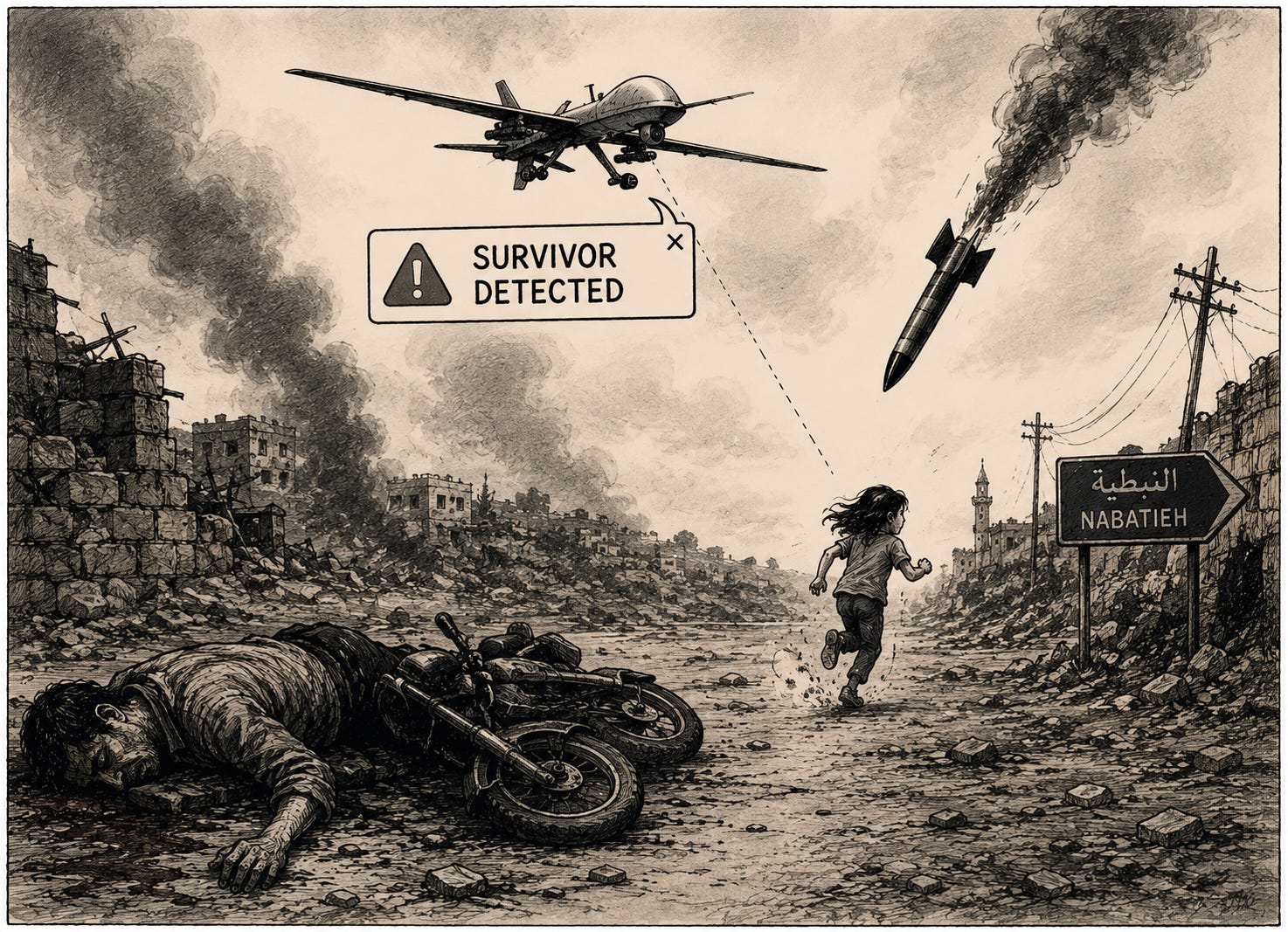
We don’t know her name, and that’s the first tragedy, but not the last. What we do know is this: she was 12, Syrian, riding on a motorcycle with her father through Nabatiyeh in southern Lebanon on May 9, 2026, and posed no threat to anyone. An Israeli drone spotted them. Then it fired. They made it out alive and ran. The drone fired once more, and her father was gone in an instant. She kept running (maybe a hundred meters), injured, alone, leaving her father’s body behind.
Please, for the love of all that matters, take a moment to imagine the fear she felt as she ran for her life; the horror of realizing the drone was following her, hunting her. That drone operator pursued her like an animal.
It fired a third time. on an innocent 12-year-old girl, after murdering her father. She was taken to the hospital (one of the only ones left standing), but she didn’t make it. Three strikes. On a child. Fleeing. On foot.
It wasn’t about geopolitics, ceasefire talks, or the meticulously vague IDF statement claiming they were “looking into it.” It was just about the girl ( those final moments, the sound, and that awful realization ), because at twelve, she was definitely old enough to think, “Well, this is happening again!” And seriously, in what bizarre fucked up cartoon universe could she have been a threat to anyone?
The Ceasefire That Isn’t
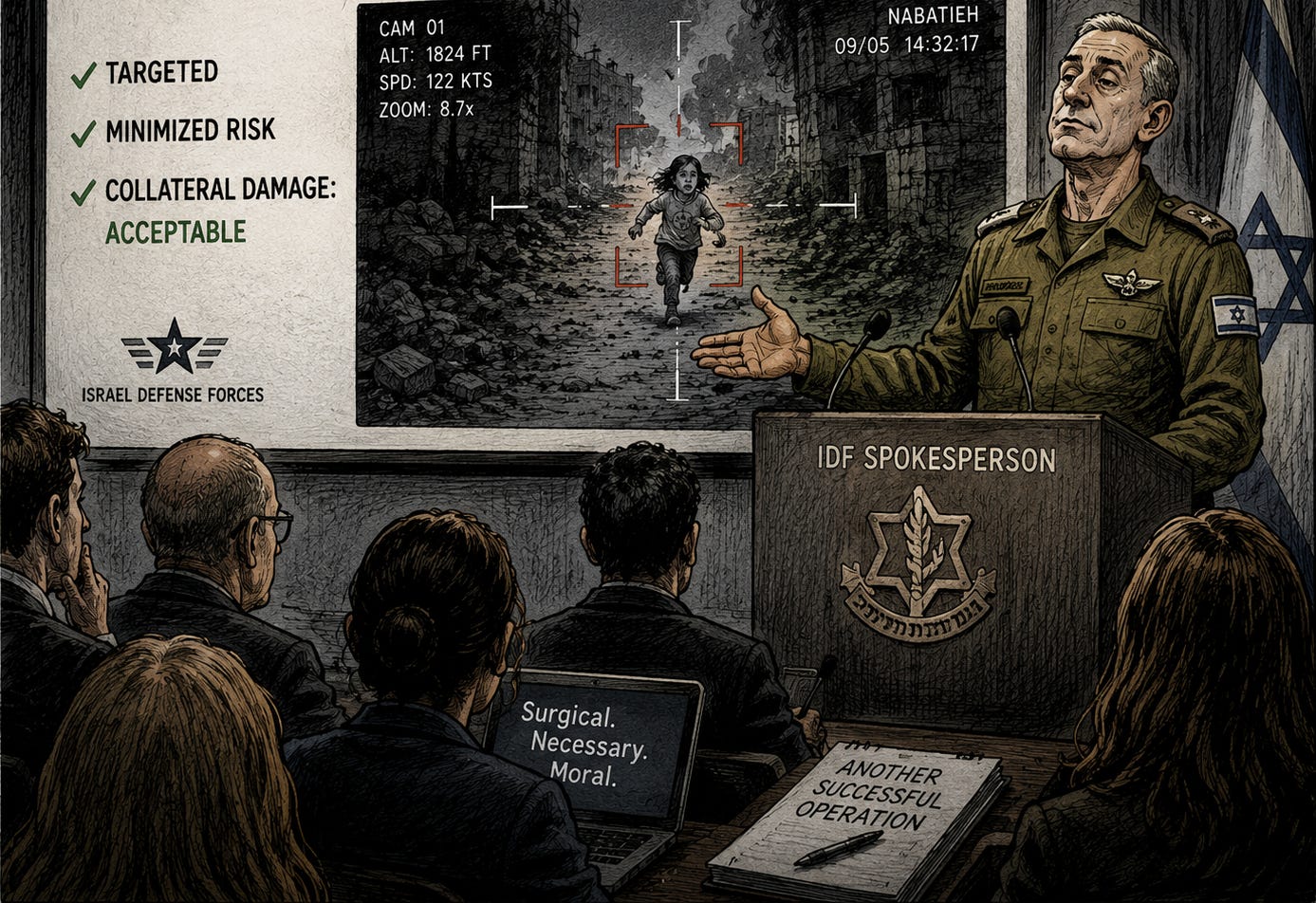
Since the ceasefire took effect on April 17th, Israel has killed 380 people in Lebanon and wounded more than 1,100 others. The overall death toll since March 2nd now stands at 2,882, including 279 women and 200 children. That’s one person killed roughly every six hours since the moment the ceasefire was declared. Not every six hours before the ceasefire. Every six hours after it.
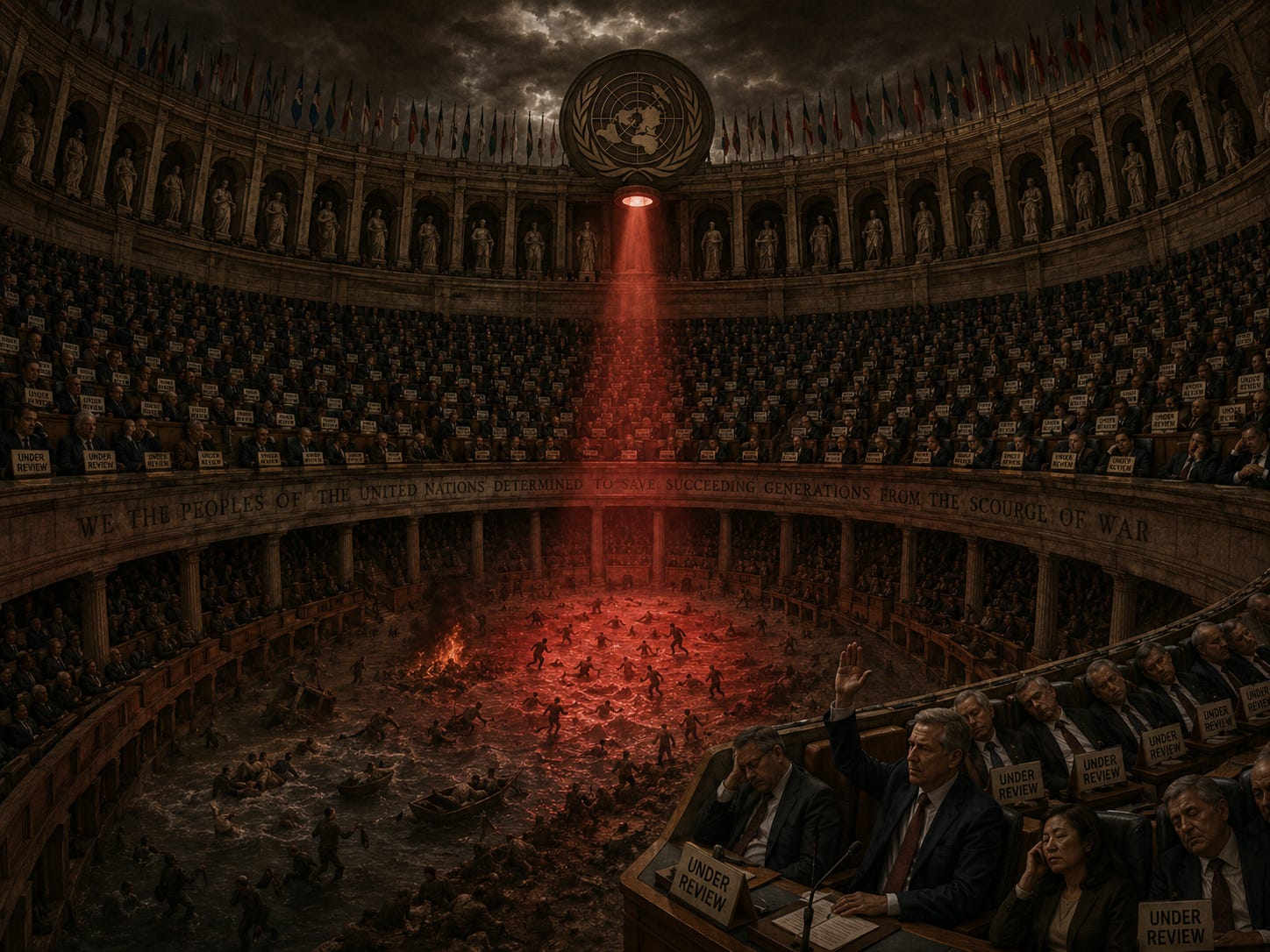
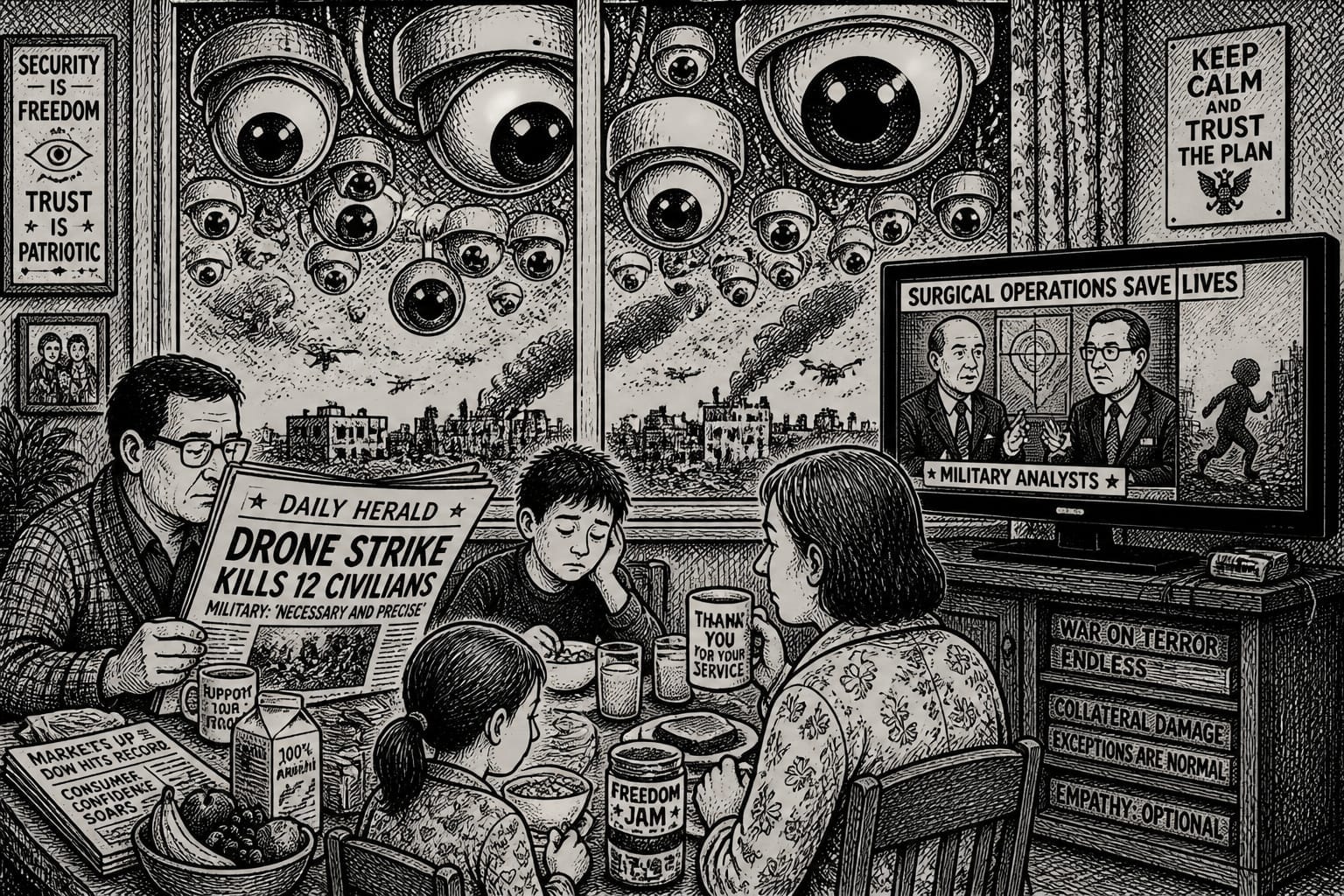
The word “ceasefire” has now graduated into that elite dictionary of political bullshit buzzwords so overused and underdelivered that uttering them straight-faced is practically a performance art. “Under review.” “Targeted military infrastructure.” “Regrettable civilian casualties.” And now “ceasefire”, which means Israel will graciously agree to slap a new label on select styles of killing, all while the body count keeps rising.
In The Witness Elimination Programme, I documented a ceasefire that popped up and dropped dead all in one April afternoon. This one’s running the same gag, only slower and with fancier promotional material. Talks in Washington limp along ( a bit like Trump is at the moment), press releases multiply like rabbits, and still the bloody body count keeps climbing. Meanwhile, in a hospital in Nabatiyeh, a 12-year-old Syrian girl fell victim to a ceasefire so committed to its craft that a drone pursued her and fired three times.
This ceasefire on the ground is less like hitting the pause button and more like slapping a fresh label on the same old chaos. Think of it as violence with a new logo; it’s the same product, just different packaging.
The Catalogue
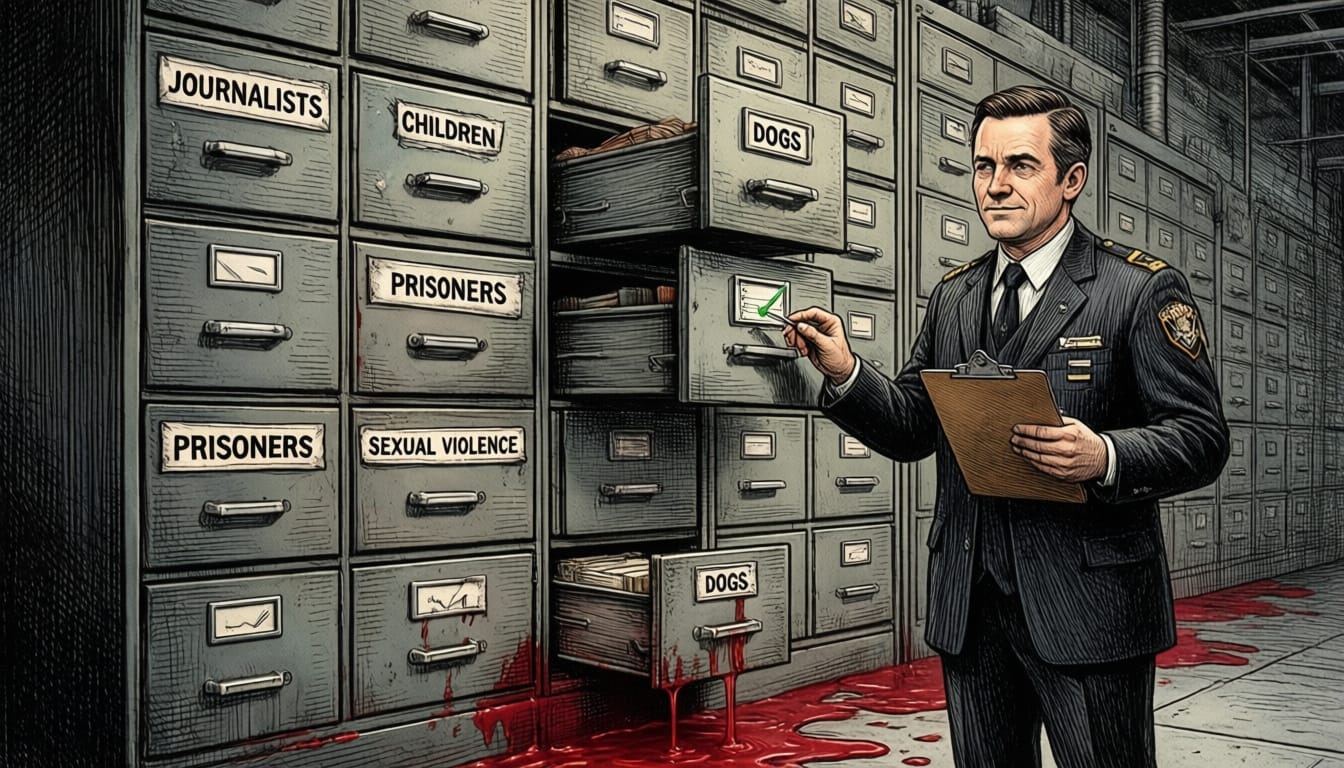
Let’s make the list. Not because lists are the proper way for humans to process horror ( they absolutely aren’t ), but because sometimes the only sane response to a catastrophe this sprawling is to stack every absurd entry in one place and make sure none of them slip quietly into the void before the next train wreck arrives.
Journalists, we’ve already covered this, but it continues to get worse. The death toll has risen from 262 to 274, with zero prosecutions. The Witness Elimination Programme is right on schedule.
Children. The overall toll in Lebanon since March 2nd stands at 2,882, including 200 children. In Gaza, the numbers stopped being countable in any way that the human mind can meaningfully hold, but let’s be totally honest, its infinetly worse than the official records. A father and his 12-year-old girl on a motorcycle in Nabatiyeh, hunted by a drone through three strikes. Her name is still unknown. Her father was dead behind her as she ran for her life.
More than 9,600 Palestinians are currently imprisoned in Israel, marking an 83 percent rise since before the war. This number includes 350 children and roughly 3,530 administrative detainees held without charge or trial. And then there’s the horror of what’s being done to them inside. A Palestinian researcher from Ramallah’s Women’s Centre for Legal Aid and Counselling spoke with 75 women detained in Gaza, the West Bank, and Jerusalem. Every one of them reported experiences of sexual violence, including rape, sexual torture, humiliation, and degradation. Her takeaway was clear: “It’s systematic. These aren’t isolated incidents or the actions of a lone perpetrator.”
According to a report by the Euro-Med Human Rights Monitor, based on documented testimonies, sexual violence against Palestinian prisoners is seen as a de facto state policy used to exert control, with a sharp increase since October 7th, 2023. The findings detail incidents of direct sexual assault, assaults with objects, torture targeting the genitals, and organized practices like filming, often involving multiple security personnel during the attacks. The UN Special Rapporteur on human rights in the Palestinian territories told the Human Rights Council that the Israeli prison system has turned into “a laboratory of calculated cruelty,” with documented abuses including rape using bottles, metal rods, and knives.
And then there are the fucking dogs(note, not figuratively, literally!). Multiple sources ( the UN, B’Tselem, Al Jazeera, and now a Nicholas Kristof investigation in the New York Times) have documented testimony from Palestinian detainees describing dogs being used to sexually assault prisoners. One prisoner at Sde Teiman told investigators: “We were stripped completely. Soldiers brought dogs that climbed on us.” Israel has denied the allegations, calling the New York Times article a blood libel. In March 2026, charges against five soldiers in the Sde Teiman case were dropped after prosecutors cited a lack of evidence following the victim’s return to Gaza. Netanyahu praised the decision, saying, “The state of Israel must pursue its enemies, not its heroic fighters.”
The testimonies come from multiple sources, verified by UN investigators and documented by Israeli human rights organizations. Yet, the accused are celebrated by their Prime Minister, though there’s a strong chance that fucker could be the Antichrist.
This isn’t a scandal. A scandal rattles the system into action. This is a policy meticulously curated, lawyer-proofed, and given a standing ovation by the political elite.
This Is What World War Three Looks Like
Turns out, we’ve been standing in line for the wrong apocalypse.
The war we were trained to dread had a clear script: two mighty rivals, a grand announcement, a neat front line, and a mushroom cloud serving as the world’s most dramatic mic drop. That show never premiered. Instead, we got this sequel, wildly scattered, sneaky, stuffed with proxies, and fueled by the hope that if no single disaster steals the spotlight, the ongoing train wreck can just blend into the tinnitus of everyday life.
Right now, at least twenty armed conflicts are raging across four continents, like a very grim world tour. They come in three flavors: the headline grabbers (Iran, Ukraine, Gaza ), the ones everyone left on “read” ( Sudan, Congo, Myanmar, Yemen), and the stealth mode wars (the Sahel, Somalia, Ethiopia, Cameroon, Pakistan-Afghanistan), and a few more lurking in the shadows.
Let’s look at a few of the ones the news cycle has decided you don’t need to know about.
In Sudan, the war between the Sudanese Armed Forces and the Rapid Support Forces is nearing its third year. Around 150,000 civilians have been killed, 12 million displaced, and about 33 million people (roughly two-thirds of the population) need humanitarian aid. The UN has described it as the world’s worst humanitarian crisis. In November 2024, Russia vetoed a UN Security Council resolution calling for a ceasefire, while every other member voted in favor.
Congo. Myanmar is now five years into a civil war. Yemen. Gaza. Ukraine, the largest conventional war in Europe since 1945, is still dragging on, with hundreds of thousands dead on both sides and no resolution in sight. Wikipedia’s list of ongoing armed conflicts ( which demands at least 100 total deaths just to make the cut) now features eight grim “overachievers,” each racking up more than 10,000 violent deaths a year. Yes, fucking eight. This isn’t just global tension; it’s a full-blown world war, but we’re stuck using a vocabulary designed for wars with neat start dates, enemies you could circle on a map, and endings that came with parades, not this messy, “check your news app” version we’ve got now.
This war is about as subtle as Donald Trump’s hatred for Jimmy Kimmel. Great power fingerprints are plastered over every battlefield, and great power deniability is served up with the sincerity of Pete Hegseth at every press conference. The United States, featuring the clown car Trump administration, is arming Israel while hawking peace like a sketchy used-car salesman. Meanwhile, Russia is brawling in Ukraine ( getting its ass handed to it, really!) as its mercenaries collect frequent flyer miles, sowing chaos in Mali. China keeps an eye on Taiwan while supporting Myanmar’s junta. The blueprint for global disaster is coming together bit by bit, conflict after conflict, right out in the open, as the international community plans yet another meeting and the death toll marches on.
And weaving through it all ( from a drone strike in Nabatiyeh to a torture camp in Gaza to a mass grave in Darfur) is the magical cloak of impunity. The ironclad, factory-installed guarantee that power gets a lifetime “no consequences” warranty. ICC warrants? Lovely wall art. Security Council veto? The deluxe, limited-edition get out of genocide freebie, and “ceasefire” simply mean whatever the biggest stick-holder feels like it means before their afternoon snack.
We’re not witnessing the world spiral into chaos; we’re watching it operate like a finely tuned machine—built, of course, to serve the folks who wrote the instruction manual and conveniently forgot to include an off switch.
What The Fuck Are We Doing
Let’s just ask it straight. No fancy flourishes, no dramatic pauses, no jazz hands.
What the actual fuck are we doing? Seriously?
We are a species that decoded the human genome, launched a space telescope so powerful it could probably spy on alien laundry lines, and kicked smallpox to the curb. We drafted the Geneva Conventions, built the International Criminal Court, and after surveying the twentieth century’s greatest hits ( muddy trenches, grim camps, and mushroom clouds), we declared, with straight faces and dramatic flair: never again... probably. And then we did it again. And again. And again. Then, just for fun, we crafted an elaborate bureaucratic obstacle course to guarantee that the culprits would stroll away scot-free, christened it the international order, and defended it with the sincerity of a mime in an invisible box. But I guess “never again” doesn’t apply to anyone outside Israel.
In southern Lebanon, a 12-year-old girl was chased down a road by a military drone and killed on the third strike after surviving the first two. Her name remains unknown, and the system that ended her life was operating exactly as designed.
Reports from the UN, Israeli human rights groups, and even a Pulitzer Prize-winning journalist detail systematic, institutionally sanctioned sexual torture of Palestinian prisoners, and yet the world’s most powerful government responds by crying “blood libel” or “antisemitism,” and making sure the weapons deliveries arrive on time, as if running a grim parody of customer service.
Two hundred and seventy-four journalists gone, not a single prosecution in sight. Twenty wars are raging like an overbooked fireworks display. Hundreds of thousands dead, millions playing the world’s worst game of musical chairs. And the Security Council? Just sitting there, frozen like someone forgot to plug it in. And all of it (every single piece) unfolding in the age of the smartphone. The era of live streams, satellite images, open-source investigators, and real-time body counts. We’re not in the dark. We can’t pretend we don’t know. We’re watching. We’re choosing, together, at the level of governments, institutions, and media systems, to watch and to let it go on.
It’s the big question everyone in power sidesteps, because the only easy answer is pretending it’s complicated. You know, the classic “there are two sides,” “geopolitics is messy,” “we must respect the sacred frameworks,” and “change takes time”, time we frankly don’t have, but apparently enough to keep kicking the can down the road. The hard truth is that these frameworks were created by the powerful to serve their own interests, and “working within them” often becomes the very process that sustains atrocities instead of stopping them. Every child lost under a ceasefire that was never genuine isn’t a breakdown of the system; it’s exactly what the system was built to produce.
In The Witness Elimination Programme, I ended with Amal Khalil, burning in the rubble, calling out her colleague’s name. The least we can do, I said, is name it. We still have to name it. But naming it, it turns out, isn’t nearly enough. We’ve been naming it for three years in Gaza, two in Sudan, and five in Myanmar. We label it, file it away, and move on to the next atrocity, while the machine keeps running.
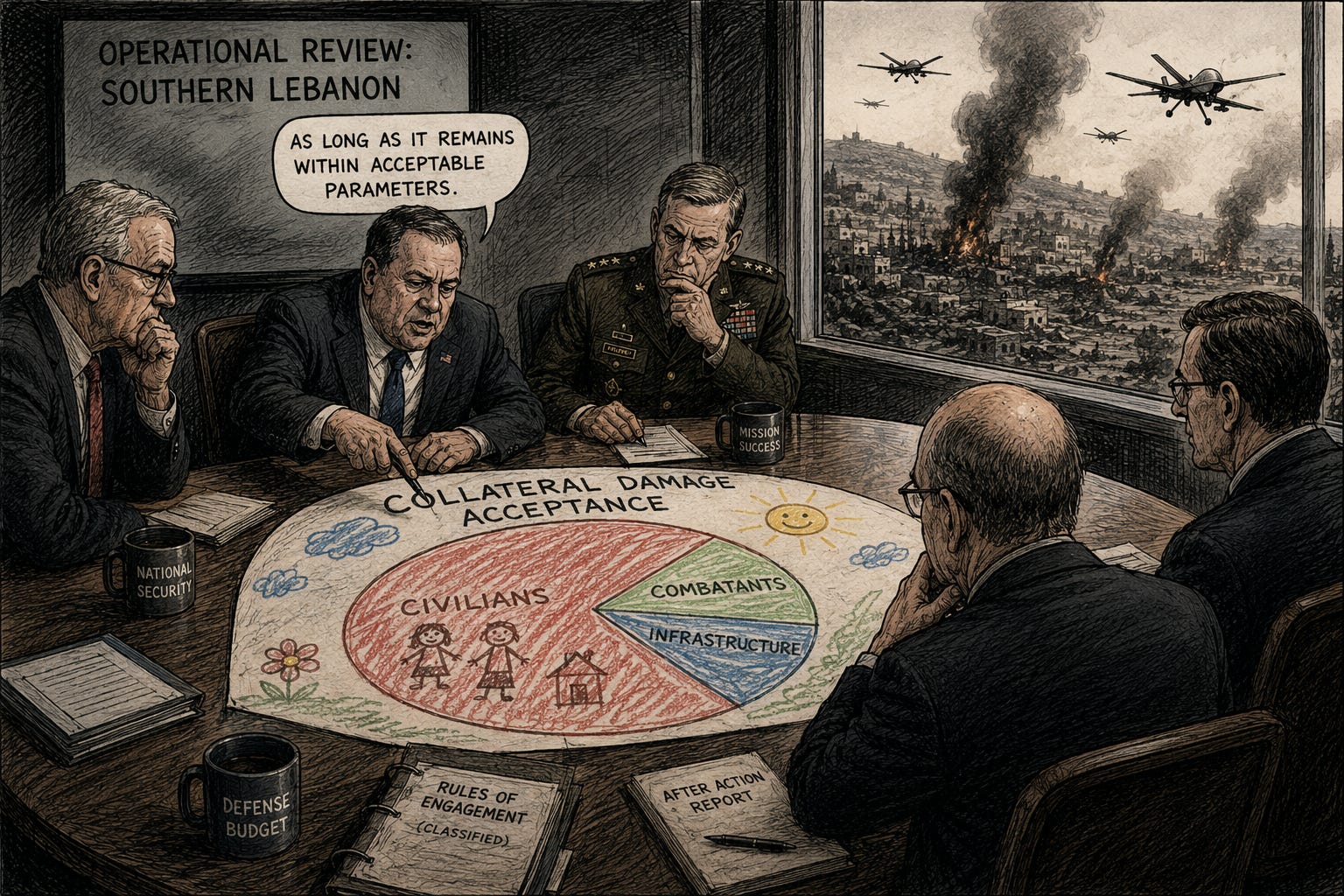
So what comes after naming? I don’t have a neat little bow to tie this up with. In fact, I get suspicious when someone does. But I do know this: accountability starts with tossing out the war criminals’ thesaurus. No “ceasefire” when the fireworks are still going off. No “under review” when the only thing under review is lunch options. And definitely no “collateral damage” when the damage has a name or would, if anyone had bothered to ask it before the third strike landed.
We don’t know her name, that innocent 12-year-old Syrian girl, riding on a motorcycle with her father through Nabatiyeh on May 9, 2026. If anyone knows who she is, if her family survived, if someone who loved her is still out there, please speak up. It’s the least we can do.
It’s truly the bare minimum, and that’s exactly where we have to begin, because right now, as a species, we haven’t even reached that.
Sources
Albanese, F. (2026) Torture and Genocide: Report of the Special Rapporteur on the situation of human rights in the Palestinian territories occupied since 1967 (A/HRC/61/71). United Nations Human Rights Council, 23 March. Available at: https://www.ohchr.org/en/press-releases/2026/03/un-expert-warns-torture-has-become-state-doctrine-israel-making-prisons
Armed Conflict Location & Event Data Project (ACLED) (2025) Conflict Watchlist 2026. Available at: https://acleddata.com/series/conflict-watchlist-2026
B’Tselem (2024). Welcome to Hell: The Israeli Prison System as a Network of Torture Camps. August. Available at: https://www.btselem.org/publications/202408_welcome_to_hell
B’Tselem (2026) Living Hell: The Israeli Prison System as a Network of Torture Camps. January. Available at: https://www.btselem.org/press_releases/20260120_living_hell
Council on Foreign Relations (2026). Conflicts to Watch in 2026. Centre for Preventive Action, January. Available at: https://www.crisisgroup.org/cmt/global/10-conflicts-watch-2026
Euro-Med Human Rights Monitor (2026) Another Genocide Behind Walls: Sexual Violence in Israeli Prisons and Detention Centres and Engineered Impunity, October 2023–October 2025. April. Available at: https://euromedmonitor.org/en/article/7022
International Crisis Group (2026). 10 Conflicts to Watch in 2026. 22 January. Available at: https://www.crisisgroup.org/cmt/global/10-conflicts-watch-2026
KrautART (2026) ‘Current Wars 2026: All Active Armed Conflicts Listed and Mapped’, March. Available at: https://www.krautart.de/global-conflicts-2026-one-machine-twenty-wars/
Kristof, N. (2026) ‘The Silence That Meets the Rape of Palestinians’, The New York Times, 11 May. Available at: https://www.nytimes.com/2026/05/11/opinion/israel-palestinians-rape-prison.html
Norwegian Refugee Council (NRC) (2026) ‘Lebanon: Nearly 600 Killed Since Fragile Ceasefire Agreed’, 13 May. Available at: https://www.nrc.no/news/2026/lebanon-nearly-600-killed-since-fragile-ceasefire-agreed
Office for the Coordination of Humanitarian Affairs (OCHA) (2026) Lebanon Humanitarian Update, May. Available at: https://www.unocha.org/lebanon
Security Council Report (2026) Lebanon: May 2026 Monthly Forecast, 1 May. Available at: https://www.securitycouncilreport.org/monthly-forecast/2026-05/lebanon-38.php
Sikora, A. (2026) ‘The Witness Elimination Programme’, austinsikora, Substack. Available at: https://open.substack.com/pub/austinsikora/p/the-witness-elimination-programme
Wikipedia (2026). List of Ongoing Armed Conflicts. Available at: https://en.wikipedia.org/wiki/List_of_ongoing_armed_conflicts [Accessed 14 May 2026]
Women’s Centre for Legal Aid and Counselling (2025) Testimony Documentation: Sexual Violence Against Palestinian Women Detainees. Ramallah: WCLAC.
Anyone who can track and shoot a 12 yr old girl should be eliminated. Depraved behavior like that can never be redeemed!
How to restack more than once 👏🏽👏🏽👏🏽